

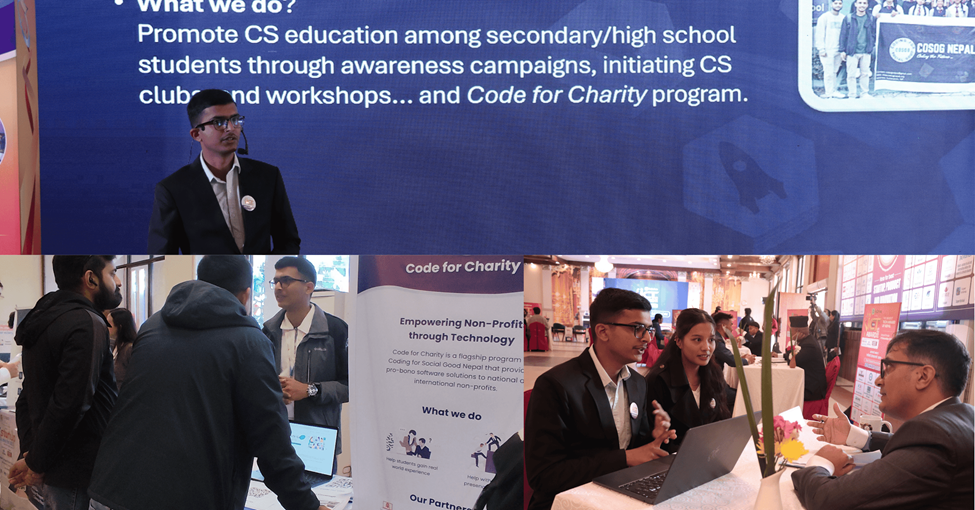

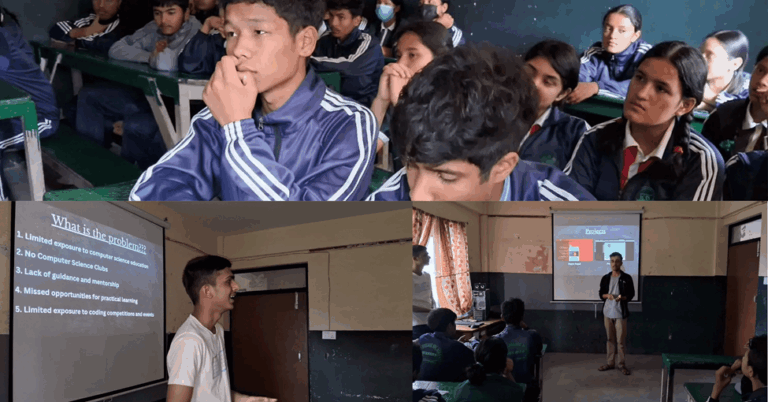
When Bibek Bhandari returned to his old high school as a STEM instructor in 2022, the outside world felt very far away than the classroom. When artificial intelligence was in global headlines, inside the school, though, computers were few, the internet was patchy, and most students had never engaged in group learning and team projects. The gap bothered him.
“I could see how quickly technology was moving globally,” Bhandari recalls. “But here, even when some tools were available, they were reaching very few students. The culture around tech just wasn’t there.”
That frustration would eventually lead him to start Coding for Social Good Nepal (Cosog Nepal), a non-profit that now works with schools, NGOs, and international partners to bring computer science education and STEM initiatives to students across the country, with Aashish Panthi. While Bhandari is the organisation’s founder and former president, the current president, Aashish Panthi, joined early in the journey, with the mission to replicate the impact he created through the ICT club in his high school.
While Bibek was moving towards a management track by pursuing CA (Chartered Accountancy), he kept noticing the lack of clubs in lower grades, and kept thinking about how much a strong computer science club can change a student’s path.
“One day I just sat down with my laptop and started designing a logo,” he says.
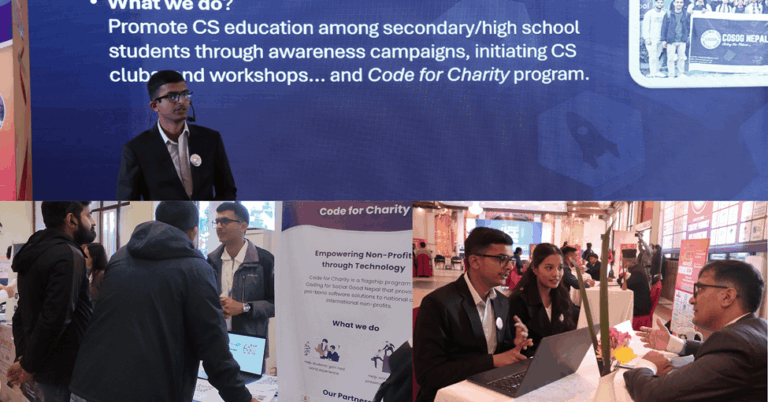
There was no design team, no official launch plan. He chose a name: Coding for Social Good Nepal and drew out a logo he now describes as “a bit strange”. The moment still stands out. “It was simple,” he says, “but it was emotional for me. I knew this was the first real step.”
Bibek met Aashish through social media. He was actively following tech pages, reading comment sections, and watching for people who seemed serious about learning and sharing. That is how he came across a young tech enthusiast from Butwal, Aashish Panthi, who is now the president of the organization.
Their first contact was a brief exchange on Instagram. They decided to meet in person. When they finally sat down to talk, the conversation stretched. “We realised very quickly that we wanted the same thing,” Aashish says. “To use our interest in technology for social work, to build a community, and to use the coding skills for a social cause that actually helps society.” The clarity from that meeting made the next steps easier. At the beginning of 2023, they decided to formalise the organization.
Their first official event took place at Green Village English Boarding Secondary School, Kirtipur. For both of them, that day in the classroom remains vivid. “The feeling was surreal,” Aashish says. “The principal told us it was the first time they had seen this kind of initiative. The students were excited, curious, and fully present.”
In the session, the team shared the concepts in digital and internet literacy, their own projects, provided handbooks, and also spoke about something more basic: the idea of a CS club. They asked students to imagine starting a computer science club inside their school, with the support of their teachers and administration. The concept was new to many of them. The response from Green Village gave the team confidence. After that, they began reaching out to more schools.
Over time, Cosog Nepal’s model settled into a pattern. The team would visit a school, run an event that mixed demonstrations with discussion, and then stay in touch via WhatsApp group and Discord server. With that approach, the organisation has now reached around 35 schools across the country.
“Students started contacting us after the events,” Bhandari says. “They would ask for help when they got stuck, whether it was starting a club, working on a project, or just a technical question. We didn’t want to be the group that visits once and disappears.” Instead, Cosog Nepal tries to act as an ongoing support system for student-led tech communities. Team members answer questions online, give feedback on early projects, and help schools plan their own events. Alongside school visits, the organization regularly shares information about hackathons, tech events, and learning opportunities, connecting students and industry professionals.
During an internal meeting, the team realised that many of the students they met were nearing the end of high school. Some wanted to pursue computer science after grade 12. Many were unsure about what that path actually looked like. To address that gap, Cosog Nepal organised a special event focused on computer science after high school. The CS in +2 program brought together four speakers from different corners of the field: a current student and Apple SWE intern, a professor, the leader of a non-profit working for women in STEM, and a CTO of a Nepali company and tech YouTuber.
The event turned into a full career counseling session. More than 200 students attended the online program and over 1,000 students watched the recorded videos across YouTube, Instagram, and Facebook page.
“Seeing that many students in one place, genuinely curious and a bit worried about their future in tech, it was overwhelming in a good way,” Aashish says. As the organization grew, a new question emerged: once students had learned some skills, where would they apply them? The answer became Code for Charity, a flagship program that connects student volunteers with real projects from NGOs and INGOs. It had a goal to provide students hands-on experience on real-world projects while helping social organizations strengthen their digital presence.
Through Code for Charity, Aashish and the team have worked with more than five organisations so far. Their first international project came through Sustainable Actions Afrika. The founder, Peter, reached out to Aashish looking for support. He was very happy to receive the help and he reflected on his experience.
In Nepal, the organization has worked with the National Adolescence Boys Network Nepal, while partnering with the Technigy Club at Duke University. After the successful delivery of the project, the National Adolescence Girls Network Nepal reached out with a request to build a website for them. Turned out, they were impressed by the website of the National Adolescent Boys’ Network Nepal during their Annual General Meeting. The quality and the work of Code for Charity gained the new demands through word of mouth.
“To replicate the real-world project development, we followed Software Development Life Cycle method and worked on iterations and different steps. We didn’t want the students to feel like it’s a school assignment,” Aashish says. Aashish has worked as a Software developer at a Switzerland based company and used his real-world experience and skills to guide the students.
The Code for Charity projects are unpaid, but the team wanted to make sure student volunteers did not stop at volunteering and get a chance to work at real tech companies. For that, the organization partnered with Corner Tech from Butwal Nepal and Fleckor Tech from Hyderabad India to offer internships and/or job opportunities. The president Aashish Panthi signed the Memorandum of Understanding and wtudents who complete their Code for Charity work can apply for these positions.
In parallel, Coding for Social Good Nepal was working on ways to use computer science education that could be help in another urgent area: the environment. Accordingly, they designed Cosog Nepal E-STEM Fellowship, a four-month program that pairs high school students with mentors to learn programming and environment and guides them to work on real environmental problems using their learningd.
For this fellowship, the organization was selected as a Global E-STEM Award winner by the North American Association for Environmental Education, which was supported by Pratt & Whitney. The innovation grant, worth 10,000 USD, will be used to strengthen the program’s structure, reach, and outcome.
The organization’s approach has draw attention. The flagship program, Code for Charity was recently named a semi-finalist for the ICT Award 2025 in Social Innovation category. Bibek himself has also received individual recognition. In 2023, he won the Citizen Entrepreneurship Competition and received the Citizen Entrepreneurship Award in Berlin from Stiftung Entrepreneurship. In 2024, he became a recipient of the Diana Award.
The president Aashish was titled Glocal’s 20 under 20 and later selected as a finalist for Glocal Teen Hero Nepal 2024, a national award recognizing his exceptional leadership in transforming computer science education for students across Nepal and using his coding skills for social good, while still in his teens.
“We see these honour as recognition of what our whole community has built,” both say. “None of this is just our story.”
The community now includes not only high school students, but also recent college students who return as volunteers. They share their own journeys with younger participants, offering a version of mentorship that feels close and attainable.
“I wasn’t able to follow my passion for technology immediately after my own graduation,” Bibek says. “That experience stayed with me. I didn’t want other students to feel that same limitation.” Looking back as the founder and former president of Cosog Nepal, he sums up the journey simply. “We started as strangers who liked technology and wanted to do some good,” he says. “Slowly, we became a community. Seeing how many students’ lives we’ve touched, that’s what makes me proud.”
Aashish acknowledges that this whole initiative shouldn’t be necessary if the nation had invested in proper research and development and the proper implement of computer science education across Nepal. “While the new interim government has mandated to have at least one Computer Science teacher in every school, our fight is much larger. We want the resources in schools to be properly used by students. We’ll continue to help them through our different programs, articles, handbooks, and social media”, Aashish added.






Comment